
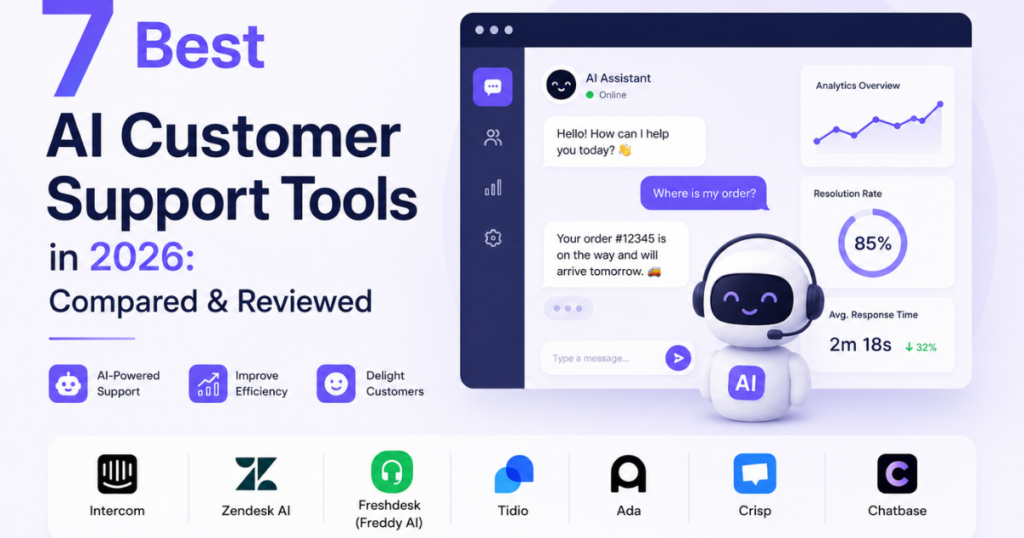
Customer support teams are under pressure to respond faster while handling more conversations with fewer resources.
That is where AI customer support tools can help.
The best platforms today can do much more than answer basic FAQ questions. They can understand customer requests, search company knowledge, retrieve information, take approved actions, and hand complicated conversations to human agents.
But not every AI support tool works the same way.
Some are built around AI agents. Others are traditional helpdesks that have added AI. Some are designed specifically for ecommerce, while others are better suited to large enterprise support teams.
We reviewed seven leading AI customer support tools based on AI capabilities, automation, knowledge management, integrations, human handoff, channels, ease of setup, pricing model, and overall fit for different businesses.
Quick Comparison: Best AI Customer Support Tools
| Rank | Tool | Best For | AI Agent | Helpdesk | Best Feature |
| 1 | Chatbase | Best overall | Yes | Yes | AI agents + actions |
| 2 | Intercom Fin | AI + helpdesk | Yes | Yes | Integrated support |
| 3 | Zendesk AI | Enterprise teams | Yes | Yes | Advanced support operations |
| 4 | Gorgias | Ecommerce | Yes | Yes | Ecommerce automation |
| 5 | Tidio | Small businesses | Yes | Yes | Easy setup |
| 6 | Freshdesk | Growing teams | Yes | Yes | Helpdesk + AI |
| 7 | Ada | Enterprise automation | Yes | Yes | AI-led support |
Our top pick
Chatbase is the best overall AI customer support tool for businesses that want an AI agent to handle customer conversations, use company knowledge, take actions, and escalate issues to humans when necessary.
Intercom is a strong alternative for companies that want AI inside a broader customer-service platform, while Gorgias is particularly attractive to ecommerce businesses.
How We Evaluated These AI Customer Support Tools
We did not rank these platforms simply by the number of features they advertise.
Instead, we looked at the areas that matter when actually deploying AI for customer support.
1. AI agent capabilities
Can the AI understand customer questions and resolve requests rather than simply returning pre-written answers?
2. Knowledge and accuracy
Can businesses train the AI using websites, documents, FAQs, product information, and other trusted sources?
3. Actions and automation
Can the AI do something useful after understanding the request?
For example:
- Look up an order
- Check customer information
- Search products
- Create a ticket
- Update information
- Trigger a workflow
4. Human handoff
Can complicated conversations move smoothly from AI to a human agent?
5. Integrations
Can the platform work with the tools a business already uses?
6. Channels
Can the AI support customers across website chat, email, messaging, and other channels?
7. Pricing
We looked at how each platform charges because the cheapest starting price isn’t necessarily the cheapest option at scale.
8. Ease of implementation
A powerful AI platform isn’t very useful if a business needs months of development to launch it.
1. Chatbase — Best Overall AI Customer Support Tool
Best for: Businesses that want an AI-first customer support platform with automation, actions, integrations, and human handoff.
Chatbase takes a different approach from traditional helpdesk software.
Instead of starting with a ticketing system and adding AI features around it, Chatbase puts the AI agent at the center of customer support.
The agent can be trained using your company’s websites, documents, help content, FAQs, and other sources. It can then use that knowledge to answer customer questions.
But the bigger advantage is that Chatbase isn’t limited to answering questions.
Its agents can connect with business systems through actions and integrations. That allows the AI to interact with real business data and perform approved tasks.
For example, a Shopify support agent can answer product questions, look up orders, retrieve cart information, and perform supported customer or store actions.
Chatbase also includes a built-in helpdesk for conversations that need human involvement.
This makes it possible to build a support workflow like:
Customer → AI agent → Action → Resolution
or:
Customer → AI agent → Human agent
rather than forcing every customer question into a traditional ticket queue.
If you’re interested specifically in ecommerce, our guide to AI agents for Shopify explains how this approach works in more detail.
Key features
- AI customer support agents
- Knowledge-based responses
- AI actions
- Shopify integration
- Helpdesk
- Human handoff
- Analytics
- Multichannel support
- Business integrations
- Custom workflows
Pros
- AI-first approach
- Strong action and automation capabilities
- Works with existing business systems
- Shopify support
- Human handoff
- Built-in helpdesk
- Suitable for support and sales use cases
Cons
- Advanced capabilities require higher plans
- Businesses looking only for basic live chat may not need the full platform
Best for
Businesses that want AI to actually handle customer-support work rather than simply answer FAQs.
Our verdict
Chatbase is our #1 pick because it combines AI agents, company knowledge, actions, integrations, analytics, and human support in one system.
2. Intercom Fin — Best AI + Helpdesk Combination
Best for: Companies that want an AI agent inside an established customer-support platform.
Intercom has a long history in customer messaging and support, and its AI agent is called Fin.
Fin can answer customer questions, resolve support requests, perform workflows, and hand conversations to human agents.
The major advantage is that AI is connected directly to Intercom’s broader support environment.
That includes:
- Shared inbox
- Tickets
- Live chat
- Help center
- Reporting
- Knowledge Hub
- Customer conversations
- Automation
Intercom’s current pricing combines seat costs with usage-based Fin charges. Its Essential plan starts at $29 per seat per month when billed annually, while Fin is charged at $0.99 per outcome.
Pros
- Mature customer-service platform
- Strong AI agent
- Excellent inbox and ticketing
- Human support workflows
- Good knowledge management
- Large integration ecosystem
Cons
- Pricing can become significant as teams and AI usage grow
- More platform than some small businesses need
Best for
Companies that want AI and a complete customer-service workspace in the same product.
Our verdict
Intercom is one of the strongest alternatives to Chatbase, especially for teams that already use Intercom or want a traditional helpdesk alongside AI.
3. Zendesk AI — Best for Enterprise Support Teams
Best for: Large organizations with established customer-service operations.
Zendesk is one of the most established names in customer support software.
Its AI capabilities sit inside a much larger support ecosystem that includes ticketing, knowledge management, reporting, customer profiles, workflows, and multiple communication channels.
This makes Zendesk particularly useful for companies with large support teams and complex processes.
The trade-off is complexity.
A company that simply wants to launch an AI support agent may find Zendesk heavier than necessary.
Pros
- Mature ticketing platform
- Strong enterprise functionality
- Advanced reporting
- Large integration ecosystem
- Useful for complex support operations
Cons
- More complex implementation
- Can be expensive at scale
- May be overkill for small businesses
Best for
Large customer-service teams that need AI alongside an established helpdesk operation.
Our verdict
Zendesk AI is a strong enterprise option, but smaller businesses may get more value from a simpler AI-first platform.
4. Gorgias — Best AI Customer Support Tool for Ecommerce
Best for: Shopify and other ecommerce brands.
Gorgias is built specifically around ecommerce customer support.
Its helpdesk connects customer conversations with ecommerce data, allowing support teams to work with orders, products, returns, and other store-related information.
Gorgias also uses outcome-based pricing for its AI Agent. Its current documentation says most plans charge around $0.90 per AI-resolved interaction with annual billing, while the exact amount depends on the plan.
Pros
- Strong ecommerce focus
- Shopify support
- AI automation
- Helpdesk and ticketing
- Order-related workflows
- Customer-service tools built for online stores
Cons
- More ecommerce-focused than general-purpose
- Costs depend on support and AI usage
Best for
Ecommerce businesses that want AI directly connected to their customer-service workflow.
Our verdict
Gorgias is one of the best choices for ecommerce, especially if your support team already works heavily with orders and tickets.
5. Tidio — Best for Small Businesses
Best for: Small businesses that want to introduce AI without a complicated support platform.
Tidio combines live chat, automation, and AI customer support.
Its main advantage is simplicity.
A small business can use it to answer common questions, provide live chat, capture leads, and automate repetitive customer conversations without deploying a large enterprise helpdesk.
Pros
- Easy to get started
- AI and live chat
- Automation
- Suitable for small teams
- Ecommerce integrations
Cons
- Advanced functionality may require paid plans
- Larger organizations may eventually need more sophisticated support infrastructure
Best for
Small businesses that want a simple way to start using AI for customer support.
Our verdict
Tidio is a good entry point for businesses that don’t need a large customer-service platform.
6. Freshdesk — Best for Growing Support Teams
Best for: Companies that want a traditional helpdesk with AI capabilities.
Freshdesk is part of the Freshworks customer-service ecosystem.
It combines ticket management, knowledge bases, automation, reporting, and AI-powered assistance.
This makes it a reasonable choice for a company that is already moving toward a structured helpdesk and wants AI to improve agent productivity and automate repetitive requests.
Pros
- Established helpdesk
- AI and automation
- Knowledge base
- Ticket management
- Reporting
- Good for growing teams
Cons
- Some advanced functionality can require additional plans
- More helpdesk-oriented than AI-first
Best for
Businesses that need a traditional support system and want to add AI capabilities.
Our verdict
Freshdesk is a solid middle-ground option between basic support software and enterprise customer-service platforms.
7. Ada — Best for Enterprise AI Automation
Best for: Large organizations that want to automate a high volume of customer conversations.
Ada focuses heavily on AI-powered customer service.
Its platform is designed around automated customer conversations and enterprise-scale support operations.
The main appeal is automation.
For businesses receiving a large number of repetitive support requests, an AI agent can potentially handle a significant portion of those interactions before they reach human agents.
Pros
- Enterprise-focused AI
- Strong automation
- Designed for high support volume
- Multilingual capabilities
- Human escalation
Cons
- Better suited to larger organizations
- Pricing and implementation can be less accessible to smaller businesses
Best for
Enterprise teams that want to automate customer service at scale.
Our verdict
Ada is worth considering for large support operations where automation volume is a major priority.
AI Customer Support Tools Compared
Here’s the simple breakdown:
| Tool | Best For | Main Strength | Main Limitation |
| Chatbase | AI-first support | AI agents + actions | Advanced features cost more |
| Intercom Fin | AI + helpdesk | Complete support workspace | Usage + seat costs |
| Zendesk AI | Enterprise | Mature support infrastructure | Can be complex |
| Gorgias | Ecommerce | Shopify/ecommerce support | Ecommerce-focused |
| Tidio | Small business | Easy setup | Less enterprise-focused |
| Freshdesk | Growing teams | Helpdesk + AI | Traditional helpdesk approach |
| Ada | Enterprise automation | High-volume AI support | Better suited to larger companies |
Chatbase vs. Intercom vs. Zendesk
These three are likely to be compared most often.
Choose Chatbase if you want:
- AI agents at the center of support
- AI actions
- Flexible integrations
- Shopify support
- Multichannel AI
- A combination of AI and human support
- The ability to connect AI with an existing helpdesk
Choose Intercom if you want:
- AI and helpdesk in one platform
- Shared inbox
- Customer messaging
- Fin AI Agent
- Knowledge Hub
- Established support workflows
Choose Zendesk if you want:
- Enterprise ticketing
- Complex support operations
- Advanced reporting
- Large-scale customer-service management
- A mature support ecosystem
For a deeper comparison, you can also read our Chatbase vs Intercom comparison.
What Makes a Good AI Customer Support Tool?
Before choosing a platform, don’t focus only on whether it has an “AI chatbot.”
Ask what the AI can actually do.
1. Can it use your own knowledge?
The AI should be able to work with your website, help center, documents, FAQs, and other trusted information.
This reduces the risk of generic answers.
2. Can it take actions?
This is one of the biggest differences between basic chatbots and AI agents.
A useful support agent should be able to connect to business systems and perform approved actions.
For example:
Customer asks about an order → AI checks the order → AI provides the current status.
3. Can humans take over?
AI should not be forced to handle every conversation.
When a customer has a complicated issue, the conversation should move to a human agent with enough context to avoid making the customer repeat everything.
4. Does it work with your existing tools?
Look at your current technology stack.
You may need integrations with:
- Shopify
- Salesforce
- HubSpot
- Zendesk
- Slack
- Stripe
- CRM systems
5. Can you measure performance?
You should be able to see whether the AI is actually helping.
Important metrics include:
- Resolution rate
- Escalation rate
- Customer satisfaction
- Response time
- Conversation volume
- AI usage
- Failed answers
6. How does pricing work?
This is extremely important.
AI support platforms can charge by:
- Seat
- Ticket
- Conversation
- Resolution
- Outcome
- AI usage
- Message
For example, Intercom currently charges $0.99 per Fin outcome in addition to its seat-based plans, while Gorgias uses outcome-based AI pricing on top of its helpdesk usage.
Don’t choose based only on the advertised starting price.
AI Chatbot vs. AI Customer Support Agent
The terms are often used interchangeably, but they aren’t always the same.
A basic chatbot might answer:
“What are your shipping times?”
An AI support agent can potentially go further:
- Understand the question.
- Identify the customer’s order.
- Check the latest order information.
- Explain the delivery status.
- Take an approved action if necessary.
- Escalate to a human if it cannot resolve the issue.
That is why the best AI customer support tools are increasingly focused on agents and actions, rather than simple scripted chatbots.
If you want to understand the broader difference, our guide to AI-powered chatbots explains how modern AI chatbots work and where businesses can use them.
How to Choose the Right AI Customer Support Tool
Use this simple checklist.
Choose Chatbase if:
You want an AI-first customer support agent that can use your business knowledge, connect with external tools, take actions, support ecommerce workflows, and hand conversations to humans.
Choose Intercom if:
You want AI combined with a complete customer-service workspace and your team needs shared inboxes, ticketing, messaging, reporting, and human support in one platform.
Choose Zendesk if:
You have a large or complex support operation and need mature ticketing and enterprise features.
Choose Gorgias if:
You’re an ecommerce business and need customer support closely connected to your store and order data.
Choose Tidio if:
You’re a small business looking for an accessible AI and live-chat solution.
Choose Freshdesk if:
You want a traditional helpdesk with AI capabilities for a growing support team.
Choose Ada if:
You’re an enterprise business looking to automate a high volume of customer conversations.
Frequently Asked Questions
What is the best AI customer support tool in 2026?
Chatbase is our top overall choice for businesses that want an AI-first customer support platform. Intercom Fin, Zendesk AI, and Gorgias are strong alternatives depending on your support model.
What is the best AI customer support tool for Shopify?
Chatbase and Gorgias are two strong options for Shopify businesses. Chatbase is particularly useful if you want an AI agent that can work with product and order information and handle both pre-purchase and post-purchase support.
You can also see our detailed guide to the best AI chatbots for Shopify.
Is Chatbase better than Intercom?
For businesses primarily looking for an AI agent, we prefer Chatbase. Intercom is a stronger option if you need a complete customer-service workspace with AI, inbox, ticketing, messaging, and human-agent workflows.
What is the difference between an AI chatbot and an AI agent?
An AI chatbot generally focuses on conversation and answering questions. An AI agent can go further by using tools, accessing data, taking approved actions, and completing workflows.
Can AI completely replace customer support agents?
Not in every situation. AI is particularly useful for repetitive and predictable requests, but human agents remain important for complex, sensitive, or unusual customer issues.
Is AI customer support expensive?
It depends on the platform and your support volume. Some tools charge per seat, while others use ticket-, conversation-, or outcome-based pricing. Always calculate the expected cost based on your actual monthly support volume.
What should I look for in an AI customer support platform?
Look at AI accuracy, knowledge sources, actions, integrations, human handoff, channels, analytics, security, setup time, and pricing. The number of features matters less than whether the platform can solve your actual support problems.
Is an AI agent better than a chatbot?
For complex customer support, an AI agent can be more useful because it can potentially access information and take actions instead of only answering questions. However, a simple chatbot may be enough for businesses with basic support needs.
Final Verdict
There is no single AI customer support tool that is perfect for every business.
But if we had to choose one platform for most businesses in 2026, Chatbase is our top pick.
The reason is its focus on AI agents rather than simply adding AI responses to a traditional support system.
Chatbase can combine company knowledge, AI agents, actions, integrations, analytics, ecommerce workflows, and human handoff. Its Shopify integration is also designed to work with live store information and support both pre-purchase and post-purchase conversations.
Intercom Fin is the strongest alternative for teams that want AI inside a mature customer-service workspace.
Zendesk AI is better suited to complex enterprise support operations.
Gorgias is a strong ecommerce choice, while Tidio is more approachable for smaller businesses.
The most important thing is to choose based on what you actually want AI to do.
If you only need answers to common questions, a basic chatbot may be enough.
If you want AI to understand customers, access business information, perform tasks, and resolve conversations, look for an AI agent platform.