
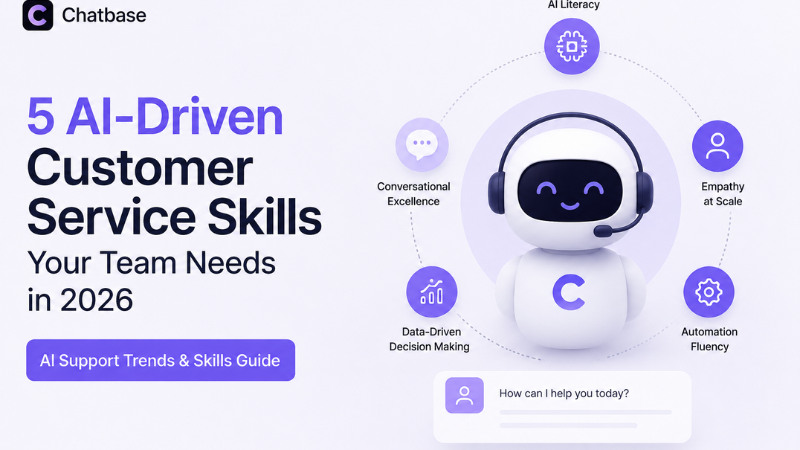
Customer service is changing faster than most teams expected.
In 2026, support teams are no longer judged only by how quickly they reply to customers. The real shift is happening behind the scenes, where AI customer service tools, chatbots, and AI agents are now handling a large share of daily support work.
How AI Is Changing Customer Service in 2026
This change is forcing teams to rethink how customer support actually works. It’s no longer just about answering tickets. It’s about working with AI systems, improving automated responses, managing knowledge bases, and understanding how customers move through support conversations.
In this article, we’ll break down the 5 most important AI-driven customer service skills your team needs in 2026, and why they matter more than traditional support skills.
1. Using AI tools in customer service workflows (AI customer support skill)
AI is now part of everyday customer service work. It helps answer questions, suggest replies, and automate simple conversations.
Support teams need to understand how to use AI tools correctly instead of fully relying on them.
This includes:
- Reviewing AI-generated responses for accuracy
- Improving or editing AI replies before sending
- Knowing when to switch from AI to human support
- Using AI to handle repetitive customer questions
This skill is becoming essential in modern AI customer support teams because it improves both speed and consistency.
2. Managing knowledge base content for AI customer support systems
AI support systems depend heavily on the content they are trained on, such as FAQs, help articles, and documentation.
If this information is outdated, AI responses will also be incorrect.
That’s why knowledge base management for AI customer service is now a core skill.
Teams should focus on:
- Keeping help center content updated
- Writing clear and simple support articles
- Removing outdated product information
- Adding new content based on customer queries
Good documentation directly improves AI chatbot accuracy and customer satisfaction.
3. Understanding customer journeys in AI-powered support systems
Customer support is no longer just answering individual tickets. Many users follow full journeys across multiple steps.
For example:
- Asking about a product
- Comparing pricing or features
- Troubleshooting an issue
- Requesting a refund or escalation
Support teams must understand these patterns to improve the full customer experience in AI-driven support systems.
This helps with:
- Reducing repeated customer queries
- Improving support flow and response speed
- Guiding users to faster resolutions
- Identifying common drop-off points
Thinking in journeys instead of tickets improves overall customer service efficiency.
4. Using data and analytics in AI customer service operations
AI support tools generate large amounts of data from customer conversations.
Support teams need to understand this data to improve performance over time.
Important areas include:
- Most common customer questions
- Resolution rates and response effectiveness
- Where customers need human support
- Repeated product or service issues
This skill is part of data-driven customer service optimization, which helps teams improve both AI and human support quality.
Without analyzing this data, it becomes difficult to improve support performance.
5. Automating customer support tasks with AI tools and workflows
Many customer service tasks are repetitive and can be automated using AI tools.
This includes checking order status, answering common questions, and updating customer records.
Teams should learn how to:
- Identify repetitive support tasks
- Set up simple automation workflows
- Connect AI tools with CRM or ecommerce systems
- Reduce manual support workload
This improves customer support automation and allows teams to focus on more complex issues.
Why human customer service skills still matter in the AI era
Even with AI, human support remains essential.
AI is good at handling simple and repetitive questions, but it struggles with complex or emotional situations.
Human agents are still needed when:
- Problems are unclear or complicated
- Customers are frustrated or upset
- Exceptions or special cases are required
- Judgment and empathy are needed
The future of customer service is not AI vs humans, it is AI and humans working together.
FAQs
What is an AI-driven customer service skill?
It’s the ability to work with AI tools in daily support work. This includes checking AI replies, improving answers, and using AI to handle common customer questions faster.
Will AI replace customer support teams in 2026?
No. AI will handle simple and repeated questions, but human agents are still needed for complex problems, complaints, and cases that need judgment or empathy.
Why does knowledge matter in AI customer support?
AI answers are based on the information it is trained on. If help articles or FAQs are unclear or outdated, the AI will also give weak or incorrect answers.
What kind of tools are used in AI customer support?
Most teams use AI chat systems that connect with help centers, CRMs, and ecommerce platforms. These tools help answer questions, manage tickets, and automate basic support tasks.
How can teams prepare for AI in customer service?
Teams need to learn how to check AI responses, improve help content, and understand basic automation. It’s less about coding and more about organizing information and reviewing outputs.
The future of AI-driven customer service in 2026
AI is transforming customer service, but the goal remains the same: helping customers solve problems quickly and clearly.
The difference is that support teams now have better tools, including AI chatbots, AI agents, and automation systems.
In 2026, the most successful teams will be those that understand how to:
- Work with AI tools
- Improve knowledge base content
- Analyze customer data
- Automate repetitive tasks
- Manage end-to-end customer journeys
These AI-driven customer service skills will define the next generation of high-performing support teams.
If you’re already experimenting with AI in customer support, the real difference comes down to how well your team adapts to these skills. Tools will keep evolving, but these fundamentals will decide how effective your support actually becomes.