
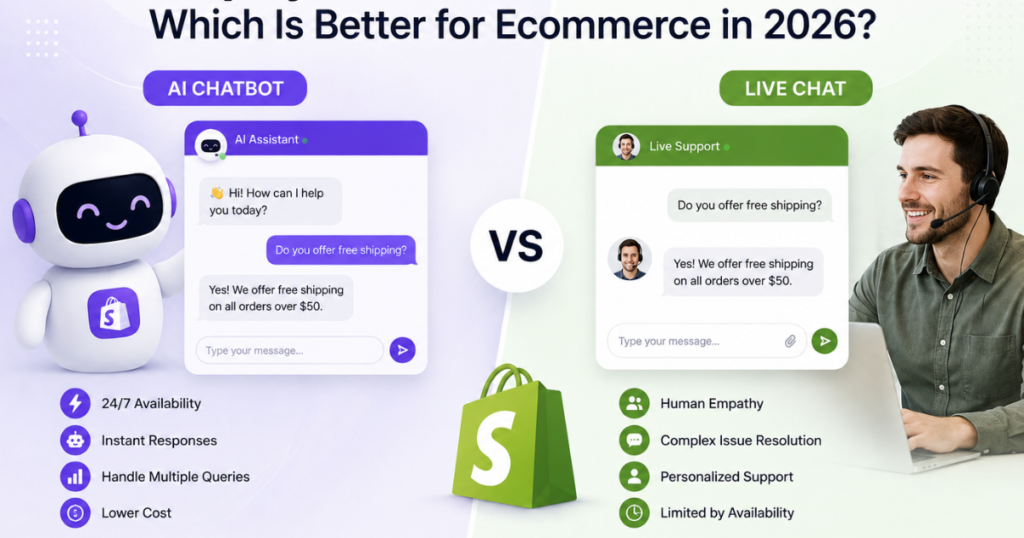
Running a Shopify store means answering customer questions throughout the day.
Some shoppers want to know which product is right for them. Others need help with shipping, returns, order status, sizing, or payment.
Traditionally, Shopify stores have relied on live chat to handle these conversations.
But AI has changed the way ecommerce businesses approach customer support.
A Shopify AI chatbot can now answer customer questions, recommend products, retrieve information, automate repetitive support requests, and in some cases take actions on behalf of the customer.
So which is better in 2026?
Shopify AI chatbots and live chat are not really competing technologies. They solve different parts of the customer-support problem.
Live chat gives customers access to human agents.
AI chatbots provide instant, automated assistance.
For most growing Shopify stores, the strongest approach is to combine both: let AI handle routine conversations and let human agents take over when a situation requires human judgment.
Shopify AI Chatbot vs. Live Chat: Quick Comparison
| Feature | Shopify AI Chatbot | Live Chat |
| 24/7 availability | ✅ | ❌ |
| Instant responses | ✅ | Usually |
| Human conversation | ❌ | ✅ |
| Handles repetitive questions | ✅ | ✅ |
| Product recommendations | ✅ | ✅ |
| Order support | ✅ | ✅ |
| Handles complex issues | Limited | ✅ |
| Multiple conversations simultaneously | ✅ | Limited |
| Automation | ✅ | Limited |
| Human handoff | ✅ | N/A |
| Scales with traffic | High | Requires more agents |
| Best for | Automation + support | Human assistance |
The key difference is simple:
Live chat connects customers with people. AI chat connects customers with an automated agent that can understand and respond to them.
What Is a Shopify AI Chatbot?
A Shopify AI chatbot is an AI-powered customer-support or sales assistant that operates on a Shopify store.
Unlike traditional rule-based chatbots, modern AI chatbots can understand natural language.
For example, a customer might ask:
“I need a waterproof jacket for hiking in cold weather. Which one would you recommend?”
A basic chatbot may not understand the request.
An AI-powered chatbot can interpret the customer’s requirements and recommend relevant products based on the store’s information.
Depending on the platform, it can also help with:
- Product discovery
- Product comparisons
- Shipping questions
- Return policies
- Order information
- FAQs
- Customer support
- Lead qualification
- Cart-related questions
- Human escalation
The most advanced solutions go one step further by connecting AI to Shopify data and business tools.
That means the AI can potentially take actions, rather than simply answer questions.
What Is Shopify Live Chat?
Live chat is a customer-support channel that allows visitors to communicate directly with a human agent.
A customer clicks the chat widget and starts a conversation.
For example:
Customer: “I ordered the wrong size. Can I change it?”
A support agent can review the situation, check the order, understand the context, and provide a personalized answer.
This human interaction is live chat’s biggest advantage.
People can handle situations where the answer isn’t clearly documented or where empathy and judgment are important.
However, live chat also has limitations.
Your team can’t be available every minute of every day unless you have enough agents and coverage.
That’s where AI becomes useful.
Shopify AI Chatbot vs. Live Chat: 8 Key Differences
1. Availability
AI chatbot
AI can operate around the clock.
Customers can ask questions at midnight, during weekends, or while your support team is offline.
This is particularly useful for Shopify stores serving customers across different time zones.
Live chat
Live chat depends on human availability.
If your team works from 9 AM to 5 PM, customers outside those hours may have to wait.
Winner: AI chatbot
For 24/7 customer support, AI has the clear advantage.
2. Response Time
AI can respond almost immediately.
A customer doesn’t need to wait for an agent to become available.
This matters because ecommerce shoppers often want answers while they are deciding whether to purchase.
For example:
“Does this product come in medium?”
or:
“Do you ship to Germany?”
An AI agent can answer immediately when the required information is available.
Live chat can also be fast, but response time depends on your team’s workload.
Winner: AI chatbot
3. Human Understanding
This is where live chat still has a major advantage.
A human agent can understand complicated situations, interpret unusual requests, and use judgment when there isn’t a straightforward answer.
For example:
“My package arrived damaged, the replacement you sent is also the wrong size, and I’m leaving the country tomorrow.”
That’s not a simple FAQ.
A human agent may be better equipped to understand the situation and decide what should happen next.
Winner: Live chat
4. Product Recommendations
AI can be extremely useful during the buying process.
Instead of forcing customers to browse hundreds of products, an AI assistant can ask questions and narrow down the options.
For example:
“I need running shoes for beginners under $100.”
The AI can use the product catalog and available product information to recommend suitable products.
This turns the chatbot into more than a support tool.
It can become a conversational shopping assistant.
Human agents can obviously do this too, but they cannot simultaneously help hundreds of visitors.
Winner: AI chatbot
5. Repetitive Customer Questions
Shopify stores receive many repetitive questions:
- What’s your return policy?
- How long does shipping take?
- Where is my order?
- Do you ship internationally?
- What sizes are available?
- Is this product in stock?
- How do I return an item?
Having human agents answer the same questions repeatedly isn’t the best use of their time.
An AI chatbot can automate many of these conversations.
This allows human agents to focus on issues that actually require their attention.
Winner: AI chatbot
6. Complex Customer Problems
AI isn’t perfect for every situation.
If a customer has a complicated complaint, a billing dispute, a special request, or an unusual problem, human support may be better.
That’s why human handoff is so important.
The ideal workflow is not:
AI replaces humans.
It’s:
AI handles simple requests → Human handles complex requests.
Winner: Live chat
7. Scalability
Imagine your Shopify store receives 10,000 visitors during a major sale.
You can’t simply hire hundreds of support agents overnight.
AI can handle many conversations simultaneously.
That’s one of its biggest advantages for growing ecommerce stores.
An AI agent can answer routine questions while your human team focuses on customers who need personal assistance.
Winner: AI chatbot
8. Cost and Efficiency
Live chat requires human resources.
As conversation volume increases, you may need more agents.
AI introduces a different cost structure.
Depending on the platform, you may pay based on:
- AI usage
- Conversations
- Resolutions
- Messages
- Seats
- Monthly plans
The exact economics depend on your support volume.
The important question isn’t simply:
“Is AI cheaper?”
Instead, ask:
How much repetitive work can AI safely handle before a human needs to step in?
That’s where the real value comes from.
AI Chatbot vs. Live Chat: Which Is Better?
There isn’t one universal answer.
It depends on what your Shopify store needs.
| If You Need… | Better Option |
| 24/7 support | AI chatbot |
| Instant answers | AI chatbot |
| Product recommendations | AI chatbot |
| FAQ automation | AI chatbot |
| Large conversation volume | AI chatbot |
| Personalized complex support | Live chat |
| Sensitive customer complaints | Live chat |
| Human judgment | Live chat |
| Empathy | Live chat |
| Best overall setup | AI + live chat |
The final option is the most important.
Why AI + Live Chat Is Better Than Choosing Only One
The strongest Shopify customer-support strategy isn’t necessarily AI or live chat.
It’s AI plus live chat.
Think of it as a two-level support system.
Level 1: AI
The AI handles:
- FAQs
- Product questions
- Shipping questions
- Basic order requests
- Product recommendations
- Common support issues
Level 2: Human
The human agent handles:
- Complex complaints
- Exceptions
- Refund disputes
- Sensitive situations
- Unusual requests
- Customers who specifically request human assistance
This creates a much more efficient workflow.
Customer → AI → Resolution
or:
Customer → AI → Human agent
Instead of sending every customer directly to a human.
Where Chatbase Fits
Among the AI customer-support platforms available to Shopify merchants, Chatbase is one of the strongest options for businesses that want AI to do more than answer basic questions.
Chatbase is built around AI agents that can use business knowledge, interact with customers, connect to tools, and perform supported actions.
For Shopify stores, this can mean handling both pre-purchase and post-purchase conversations.
For example, an AI agent can help shoppers discover products and answer questions before a purchase.
After the purchase, it can help with order-related requests and other support questions.
Chatbase’s Shopify integration is designed to work with Shopify data and supports actions involving products, orders, carts, and customer information.
This is an important difference between an AI agent and a traditional chatbot.
A traditional chatbot might say:
“You can check your order status here.”
An AI agent can potentially retrieve the relevant information and provide the customer with a more direct answer.
You can learn more about the approach in our guide to AI agents for Shopify.
Why Chatbase Is a Strong Choice for Shopify Stores
There are several reasons Chatbase stands out.
AI-first customer support
Chatbase puts AI agents at the center of the customer experience.
The goal isn’t simply to add an AI reply button to an existing helpdesk.
It’s to allow an AI agent to handle customer conversations and perform useful tasks.
Product discovery
Customers can ask natural-language product questions rather than navigating your catalog alone.
For example:
“What’s the best laptop bag for someone who travels every week?”
The AI can help narrow down the options based on available store information.
Shopify actions
The more useful AI agents become when they can interact with live business data.
Chatbase’s Shopify integration supports actions involving areas such as orders, carts, products, and customer information.
Human handoff
AI doesn’t need to handle every conversation.
When a request needs human involvement, the conversation can be escalated.
This gives businesses the benefits of automation without removing human support completely.
Multichannel support
Customer conversations don’t always happen on your Shopify storefront.
Modern AI customer-support platforms can extend support across channels such as website chat, email, WhatsApp, and social messaging.
Chatbase supports multiple deployment channels, helping businesses build a broader AI customer-support workflow.
If you’re interested in the wider concept, our guide to AI-powered chatbots explains how AI chatbots are being used across different business functions.
When Should a Shopify Store Use Live Chat?
Live chat is still valuable.
You should consider keeping or adding live chat if:
Your products are expensive
Customers buying expensive products may want to speak with a real person before making a purchase.
Your products are complicated
If customers need expert advice, human support can be important.
Your customers frequently have unusual problems
AI is best at predictable and repeatable requests.
If your support team frequently handles exceptions, live agents remain essential.
Your brand depends on personal service
Some businesses compete on customer experience rather than just price.
Human interaction can be part of that experience.
When Should a Shopify Store Use an AI Chatbot?
AI makes more sense when:
- Your team receives many repetitive questions.
- Customers need support outside business hours.
- You have a large product catalog.
- Customers frequently ask product questions.
- Your support team is overwhelmed.
- You want to automate order-related questions.
- You want faster responses.
- You want to scale support without adding agents for every additional conversation.
For these stores, AI can reduce the amount of routine work reaching human agents.
Shopify AI Chatbot vs. Live Chat: Best Choice by Store Size
Small Shopify stores
A small store with low support volume may not need an advanced AI system.
Start with basic live chat or a simple AI chatbot and expand as customer volume increases.
Growing Shopify stores
This is where AI can provide significant value.
As conversations increase, repetitive questions can consume more and more staff time.
An AI chatbot can handle common questions while humans handle exceptions.
Large Shopify stores
Large stores often benefit from combining both.
AI can provide first-line support while human agents handle complex cases.
This creates a scalable support model without sacrificing human assistance.
How to Combine AI Chatbot and Live Chat on Shopify
A practical setup could look like this:
Step 1: Train the AI
Provide information about:
- Products
- Shipping
- Returns
- Refunds
- FAQs
- Store policies
- Customer-support procedures
Step 2: Connect Shopify data
Give the AI access to the information it needs to answer store-specific questions.
Step 3: Define what AI can handle
For example:
- Product questions
- Shipping questions
- Basic order requests
- FAQs
Step 4: Define escalation rules
Tell the AI when it must transfer the conversation.
For example:
- Customer asks for a human.
- Customer has a complex complaint.
- AI doesn’t have enough information.
- The request requires human approval.
Step 5: Test real conversations
Don’t test only perfect questions.
Test:
- Misspellings
- Short questions
- Complicated questions
- Product comparisons
- Unusual requests
- Angry customers
- Multiple questions in one message
Step 6: Monitor results
Look at:
- Resolution rate
- Escalation rate
- Customer satisfaction
- Unanswered questions
- Common support topics
- Conversion impact
Then improve the AI based on what customers are actually asking.
Common Mistakes to Avoid
Mistake 1: Replacing every human conversation with AI
AI shouldn’t automatically handle everything.
Keep humans involved where judgment and empathy matter.
Mistake 2: Using outdated product information
An AI chatbot is only as useful as the information it can access.
Keep product details, pricing, policies, and inventory-related information accurate.
Mistake 3: Making the chatbot difficult to reach
Customers shouldn’t feel trapped inside an automated conversation.
Make human escalation easy.
Mistake 4: Using AI only for FAQs
FAQs are a good starting point, but modern AI agents can potentially handle much more.
Think about product discovery, order support, customer qualification, and business actions.
Mistake 5: Measuring only chatbot conversations
More conversations aren’t necessarily better.
Focus on outcomes:
- Was the customer helped?
- Was the issue resolved?
- Did the customer purchase?
- Did the conversation need human escalation?
- Did support workload decrease?
Final Verdict: Shopify AI Chatbot or Live Chat?
If you have to choose one, the right answer depends on your business.
Choose live chat if your customers need frequent human assistance and your support volume is manageable.
Choose an AI chatbot if you want 24/7 support, instant responses, product recommendations, and automation.
But for most growing Shopify stores, the best answer is both.
Use AI for repetitive, predictable conversations.
Use human agents for complex and sensitive issues.
And if you’re looking for an AI-first solution that can go beyond basic FAQs and connect customer conversations with Shopify data and actions, Chatbase is our top recommendation.
It gives Shopify merchants a way to move from a simple chatbot toward a more capable AI customer-support agent.
For another look at the leading Shopify options, check out our comparison of the best AI chatbot Shopify apps.
Frequently Asked Questions
Is an AI chatbot better than live chat for Shopify?
An AI chatbot is better for automation, instant responses, 24/7 availability, and repetitive questions. Live chat is better for complex problems that require human judgment. For many stores, combining both is the strongest approach.
Can Shopify AI chatbots replace live chat?
They can reduce the number of conversations that need human agents, but they don’t have to replace live chat completely. A better model is AI handling routine conversations and live agents handling complex cases.
What is the best AI chatbot for Shopify?
Chatbase is our top choice for Shopify stores that want an AI agent capable of handling customer support, product discovery, Shopify-related information, automation, and human handoff.
Can an AI chatbot recommend Shopify products?
Yes. AI chatbots can use product information to help customers discover products based on their needs, preferences, and questions.
Can AI chatbots track Shopify orders?
Some Shopify AI chatbots can access order information through Shopify integrations. The exact capabilities depend on the platform and permissions available.
Do Shopify AI chatbots work 24/7?
Yes. AI chatbots can operate continuously, allowing customers to receive assistance outside normal business hours.
Should a small Shopify store use an AI chatbot?
It depends on the support volume. If customers frequently ask repetitive questions or need help outside business hours, an AI chatbot can be useful even for a small store.
What is the difference between an AI chatbot and an AI agent?
A chatbot generally focuses on conversation and answering questions. An AI agent can go further by using tools, accessing business information, and performing approved actions.
Is live chat still useful in 2026?
Yes. Human support remains important for complicated, sensitive, and unusual customer situations. The role of live chat is increasingly becoming complementary to AI rather than being replaced by it.